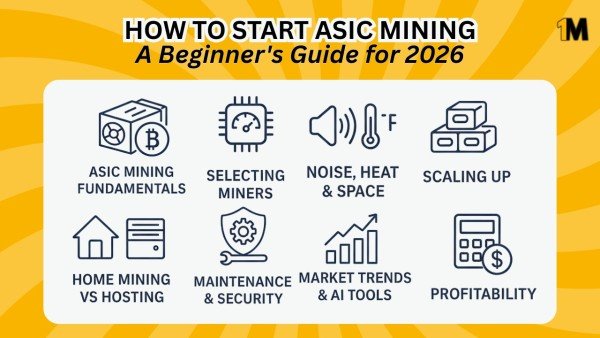
Bitcoin Mining for Beginners — How to Start, Hardware Choices, Profitability & Safety
By Alex R. Stone — Senior Mining Engineer & Crypto Researcher. Published: 2024-11-10. Last updated: 2026-04-10.
Author bio: Alex R. Stone has 9 years designing and operating cryptocurrency mining facilities, an M.Eng. in Electrical Engineering, and published articles on mining efficiency and risk management. LinkedIn: https://www.linkedin.com/in/alex-r-stone (example).
YMYL / Financial disclaimer: This article is educational only and is not financial, legal, or tax advice. Mining profitability depends on many variable inputs (BTC price, difficulty, electricity, hardware costs). Always consult a licensed financial or tax professional and verify local regulations before starting mining operations.
Quick Answer
Bitcoin mining for beginners is the process of using specialized hardware (ASIC miners) to secure the Bitcoin network and earn block rewards. Start by choosing a modern ASIC miner, calculating profitability (hashrate, power use, electricity cost, BTC price), joining a reputable pool, securing mined coins in a hardware wallet, and ensuring proper electrical and cooling infrastructure.

Why This Guide: Bitcoin Mining for Beginners
This guide replaces generic advice with practical, verified information: a vetted ASIC comparison table, full hands-on setup steps (power, PSU, wiring, network), concrete profitability worked examples, security best practices, regulatory notes, visual placeholders, and authoritative sources for further reading. The aim is to give beginners a realistic path to evaluate and start mining safely and profitably.
What is Bitcoin mining? (Featured snippet optimized)
Bitcoin mining validates transactions and secures the network by solving cryptographic work using specialized ASIC hardware; miners are rewarded with newly issued BTC plus transaction fees. (~40–60 words optimized)
Verified Comparison Table of Popular ASIC Miners (2024–2026)
Below are commonly recommended ASICs for new miners with manufacturer specs and independent benchmark references. Prices vary by region and time; shown price ranges reflect typical retail/resale levels in 2024–2026. Always verify current specs and pricing on the manufacturer or reseller page before purchase.
| Model | Manufacturer | Hashrate (Th/s) | Power (W) | Efficiency (J/Th) | Typical Noise (dB) | Estimated Price Range (USD) | Sources |
|---|---|---|---|---|---|---|---|
| Antminer S19j Pro | Bitmain | ~104 Th/s | ~3068 W | ~29.5 J/Th | 75–78 dB | $1,200 – $3,500 | Bitmain S19j Pro, ASICMinerValue benchmarks |
| Antminer S19 XP | Bitmain | ~140 Th/s | ~3010 W | ~21.5 J/Th | 75–78 dB | $3,000 – $7,500 | Bitmain S19 XP, ASICMinerValue |
| Whatsminer M50S+ | MicroBT | ~126 Th/s | ~3276 W | ~26 J/Th | 75–80 dB | $2,500 – $6,000 | MicroBT M50S+, benchmarks |
| AvalonMiner 1246 | Canaan | ~90 Th/s | ~3420 W | ~38 J/Th | 75–79 dB | $800 – $2,000 | Canaan Avalon 1246, benchmarks |
Notes: Hashrate and power figures are manufacturer nominal specs; real-world figures vary by firmware and ambient temperature. Noise levels are measured at 1 m and vary with fan speed. For updated, model-specific benchmarks consult manufacturer pages and independent benchmark aggregators (links above).

Sources & Further Reading
- Bitcoin Whitepaper — Satoshi Nakamoto
- Bitcoin.org — General reference
- Bitmain (Antminer product pages)
- MicroBT (Whatsminer product pages)
- Canaan (Avalon product pages)
- Cambridge Bitcoin Electricity Consumption Index (CBECI) — energy usage data
- F2Pool, Poolin, AntPool — mining pool docs and payout methods
- ASICMinerValue — independent miner performance & benchmarks
Profitability Explained — How to Calculate Break-Even
Profitability depends on five core inputs:
- Miner hashrate (Th/s)
- Network hashrate (Th/s) and block reward
- Power consumption (W) and electricity cost ($/kWh)
- Pool fees and operational expenses
- BTC price
Core formula to estimate daily BTC mined:
Daily BTC = (Your Hashrate / Network Hashrate) × Blocks per Day × Block Reward × (1 − Pool Fee)
Where:
- Blocks per day ≈ 144
- Current block reward (post-2024 halving) = 3.125 BTC (confirm at Bitcoin.org)
Electricity cost per day (USD) = (Power (W) ÷ 1000) × 24 × Electricity ($/kWh)
Net revenue per day (USD) = BTC mined per day × BTC price − Electricity cost per day − Pool fees (if charged in USD)
Worked examples
Assumptions common to all examples:
- Blocks/day = 144
- Block reward = 3.125 BTC
- Network hashrate = 350 EH/s = 350,000,000 Th/s (example; check current network hashrate at block explorers)
- Pool fee assumed 1% unless otherwise stated
Example A — Home miner with high electricity (Antminer S19j Pro)
- Miner: Antminer S19j Pro — 104 Th/s, 3068 W
- Electricity: $0.30 per kWh
- BTC price: $40,000
Daily BTC = (104 / 350,000,000) × 144 × 3.125 × (1 − 0.01) ≈ 0.000134 BTC/day
Daily BTC value = 0.000134 × $40,000 ≈ $5.36
Electricity/day = (3068 W / 1000) × 24 × $0.30 ≈ $22.09/day
Net/day ≈ $5.36 − $22.09 = −$16.73 (loss)
Interpretation: At $0.30/kWh and $40k/BTC, this configuration is likely unprofitable. Break-even requires lower electricity, higher BTC price, or higher-efficiency hardware.
Example B — Efficient commercial setup (Antminer S19 XP)
- Miner: Antminer S19 XP — 140 Th/s, 3010 W, efficiency ~21.5 J/Th
- Electricity: $0.05 per kWh
- BTC price: $50,000
Daily BTC = (140 / 350,000,000) × 144 × 3.125 × 0.99 ≈ 0.000181 BTC/day
Daily BTC value = 0.000181 × $50,000 ≈ $9.05
Electricity/day = (3010 / 1000) × 24 × $0.05 ≈ $3.61/day
Net/day ≈ $9.05 − $3.61 = $5.44/day
Monthly ≈ $163; yearly ≈ $1,986 (not accounting for hardware cost, depreciation, downtime, maintenance)
Example C — Hobby miner (AvalonMiner 1246)
- Miner: AvalonMiner 1246 — 90 Th/s, 3420 W
- Electricity: $0.12 per kWh
- BTC price: $45,000
Daily BTC = (90 / 350,000,000) × 144 × 3.125 × 0.99 ≈ 0.000116 BTC/day
Daily BTC value = 0.000116 × $45,000 ≈ $5.22
Electricity/day = (3420 / 1000) × 24 × $0.12 ≈ $9.85/day
Net/day ≈ $5.22 − $9.85 = −$4.63 (loss)
Interpretation: At $0.12/kWh and current network assumptions, Avalon 1246 is likely unprofitable without cheaper electricity or higher BTC price.
Important: These examples use a static network hashrate and BTC price. Real-world profitability is dynamic. Use a live mining profitability calculator (links below) for current results.
Live tools & calculators: Mining Profitability Calculator (internal), CoinWarz BTC Calculator, ASICMinerValue.
Step-by-Step Guide: Bitcoin Mining for Beginners
This hands-on setup guide covers hardware selection, PSU sizing, electrical wiring, network setup, firmware configuration, cooling, and initial troubleshooting.
1. Choose your miner
- Match hashrate/efficiency to your electricity cost. See the verified table above.
- Confirm warranty, firmware support, and reseller reputation. Prefer factory-direct or authorized resellers.
- Check physical dimensions and weight for mounting/cooling planning.
- Internal link: ASIC miner reviews
2. Power supply unit (PSU) and connectors
- Most modern ASICs include a dedicated PSU or specify required PSU wattage and PCIe connectors.
- Calculate required wattage: Miner power × number of miners × 1.10 (10% overhead for inefficiency and fans).
- Use industrial-grade PSUs with 80 PLUS efficiency or the manufacturer-supplied PSU. Avoid using PC PSUs unless supported.
- Ensure correct PCIe power cables and maintenance of connectors to avoid voltage drop.
3. Electrical wiring, breakers, and safe installation
- Hire a licensed electrician to install dedicated circuits and appropriate breakers. ASICs draw continuous high current; run dedicated circuits with correct gauge wiring.
- Calculate current draw: Current (A) = Power (W) / Voltage (V). For example, 3068 W ÷ 240 V ≈ 12.8 A per miner.
- Use GFCI/RCD where local code requires, install surge protection, and ensure ventilation and clearance from combustible materials.
- Consider three-phase power or split-phase setups for large clusters; consult electrician for capacity planning.

4. Cooling and ventilation
- Rough rule: One miner produces ~3kW heat. Plan airflow, intake, and exhaust to remove heat efficiently.
- Use ducting, intake filters, and inline fans for enclosed spaces. Maintain ambient temperature 10–30°C for optimal reliability.
- Monitor humidity and avoid condensation. For larger operations, consider evaporative cooling or HVAC integration.
5. Network & IP setup
- Connect miners via Ethernet to a reliable router/switch. Wi-Fi is not recommended.
- Assign static IPs or reserve DHCP addresses for each miner to simplify management.
- Open only necessary outbound ports and use a firewall. Miners typically communicate over standard HTTP/HTTPS to pool endpoints.
- For remote management, set up a VPN (recommended) or secure jump host; avoid exposing miner web interfaces to the public internet.
6. Miner firmware and pool configuration
- Log into the miner’s web UI (default IP displayed via DHCP). Change admin password immediately.
- Set pool URL, worker name, and password according to pool documentation (e.g., stratum+tcp://pool:port/).
- Example pool config fields: Pool URL, Port, Worker (walletaddress.worker1), Password (x or custom).
- Update firmware only from official vendor sources to avoid malicious firmware.
7. Monitoring, maintenance & backups
- Use monitoring tools (internal link: mining monitoring tools) or pool dashboards to track uptime, temperature, and hashrate.
- Schedule periodic cleaning (filters, fans) and replace failing fans early.
- Maintain an inventory of spare parts (fans, PSU, cables) to minimize downtime.
8. Initial troubleshooting checklist
- Miner not booting: check PSU connections and voltage, review status LEDs.
- Low hashrate: confirm pool settings, check temperatures and firmware version.
- Frequent reboots: check power stability, breaker trips, ambient temperature.
- Network issues: confirm static IP, gateway, and DNS settings; try direct switch connection.
Security Considerations: Wallets, Custody & Network Security
Security is critical: miners are gateways to funds. Protect private keys and networked devices.
Wallet options & recommendations
- Hardware wallets (recommended): Ledger (Ledger Nano S Plus, Ledger Nano X), Trezor (Trezor Model T). These provide offline private key storage and are industry-standard. See vendor guides for setup.
- Software wallets: Electrum (desktop), Sparrow Wallet (desktop advanced). Use only on secure, updated systems.
- Custodial wallets/exchanges: convenient but place private keys under third-party control; not recommended for long-term storage of mined BTC.
- Best practice: use a hardware wallet or multisig for storage of mine proceeds above operational thresholds.
Seed backup and recovery
- Write seed phrases on fireproof steel plates or paper and store in secure, geographically dispersed locations.
- Use metal backup products to protect against fire/flood.
- Test restore procedure on a clean device periodically to ensure backups are valid.
Network security for miners
- Place miners on a segmented VLAN with strict firewall egress rules.
- Disable remote admin interfaces accessible from the internet; use VPN for remote management.
- Change default passwords and regularly rotate credentials.
- Monitor logs for suspicious outbound connections (could indicate malware/miner redirect).
Pool security & payout methods
- Pool payout methods: PPS (Pay Per Share), PPLNS (Pay Per Last N Shares), PPS+ and FPPS vary by risk and variance. Beginners often prefer PPS/PPS+ for predictable payouts but accept slightly lower long-term returns.
- Review pool fee structure, minimum payout thresholds, and payout frequency. Use reputable pools with transparent history (F2Pool, Poolin, AntPool).
- Enable payout address whitelisting where available to prevent unauthorized address changes.
Regulatory & Legal Considerations
Legal and tax treatment of mining varies by jurisdiction. Before starting:
- Check if mining requires permits, business registration, or special utility agreements locally.
- Understand tax obligations: mined BTC may be treated as income at fair-market value at time of receipt; consult a tax advisor.
- Contact your utility to confirm whether residential/commercial rates or industrial meter conversion is required for high-power use.
- Energy and environmental regulations may restrict large-scale installations or require emissions reporting.
Environmental Impact & Mitigation Strategies
Bitcoin mining consumes energy; mitigate environmental impact by:
- Locating near low-carbon grids or surplus renewable generation.
- Using waste-heat recovery for greenhouse or industrial heating.
- Sourcing renewable energy via PPAs or on-site solar where feasible.
- Optimizing efficiency — higher J/Th hardware reduces energy per hash.
For energy usage data, see the Cambridge Bitcoin Electricity Consumption Index: CBECI.
Internal Linking Recommendations
Recommended internal links to improve topical authority:
- ASIC miner reviews — link from hardware sections
- Cryptocurrency wallets guide — link from wallet/security
- Mining pool comparisons — link from pool section
- Electricity cost optimization — link from profitability section
Visual Content (Placeholders)
Include the following visuals on the live page for user engagement and clarity:


FAQ
How to calculate mining break-even?
Use the formula in the Profitability section: estimate BTC/day from hashrate share, multiply by BTC price, subtract electricity and fees. Use live calculators for accurate, current results.
What is cloud mining and is it recommended?
Cloud mining rents remote hashing power from a third party. It carries counterparty, fraud, and contract risk. For beginners, renting hardware from reputable colocators or buying a miner is generally safer than most cloud contracts.
How does Bitcoin halving affect mining rewards?
Halving reduces the block subsidy by 50% roughly every four years, lowering miner revenue from newly issued BTC. Miners rely on transaction fees and efficiency to remain profitable; halving increases pressure on less efficient miners.
What pool payout method is best for beginners?
PPS or PPS+ offers predictable payouts and low variance, which is often preferable for beginners. PPLNS can yield higher long-term returns but has greater variance.
Should I mine at home or use colocation?
Home mining is accessible but often faces higher electricity costs, noise, and home safety constraints. Colocation reduces noise and can access cheaper power and better cooling but requires capital and contract negotiations.
How do I secure my mined Bitcoin?
Use hardware wallets (Ledger, Trezor) and keep seed backups offline on metal plates. Use wallet address whitelisting and keep small operational balances online for payouts only.
Can I use GPUs to mine Bitcoin?
No — Bitcoin mining is dominated by ASICs. GPUs are used for other PoW coins (e.g., Ethereum historically) but not Bitcoin, where ASICs are far more efficient.
How often should I update miner firmware?
Only update firmware from official vendor sources and when updates fix bugs or improve efficiency; test updates on one unit before mass deployment.
What ongoing maintenance do miners need?
Regular cleaning of fans and filters, monitoring temperatures, replacement of worn fans and PSUs, and checking for firmware/firmware rollbacks. Keep spare parts inventory for quick repairs.
Is mining profitable if Bitcoin price halves?
Profitability depends on many factors; a drop in BTC price reduces revenue. To survive downward price moves, miners need low electricity costs, efficient hardware, or hedging strategies.
Key Takeaways
- Bitcoin mining for beginners requires verifying hardware specs and realistic profitability calculations before buying an ASIC.
- Electricity cost and miner efficiency (J/Th) are the most important drivers of profitability.
- Prioritize safety: licensed electrical work, proper cooling, and network segmentation.
- Secure mined funds with hardware wallets and follow backup best practices.
- Understand regulatory and tax obligations in your jurisdiction before operating.
Conclusion
Bitcoin mining for beginners is accessible but requires realistic expectations, verified hardware selection, safe electrical and networking practices, and careful security of funds. Use the verified ASIC table, run the profitability calculations with current network data, and consult local professionals for wiring and tax/regulatory advice. Start small, monitor performance, and scale only when you have proven a sustainable economics for your setup.
About the Publisher
This guide is published by CryptoOps Media — editorial policy: technical articles are reviewed by experienced miners and an independent editor. Corrections and updates are performed when new vendor data or network conditions change.
Sources & Citations
- Bitcoin Whitepaper — https://bitcoin.org/bitcoin.pdf
- Bitcoin.org consensus and block reward info — https://bitcoin.org/
- Bitmain product pages — Antminer S19 series & S19 XP — https://shop.bitmain.com
- MicroBT product pages — Whatsminer M50S series — https://www.microbt.com
- Canaan product pages — AvalonMiner models — https://www.canaan.io
- Cambridge Bitcoin Electricity Consumption Index (CBECI) — https://www.cbeci.org
- F2Pool, Poolin, AntPool — pool documentation and payout methods — https://www.f2pool.com, https://poolin.com, https://www.antpool.com
- ASICMinerValue — independent miner benchmarks — https://asicminervalue.com